
News
D4vd Charged With Murder and Pleads Not Guilty in Death of Celeste Rivas Hernandez

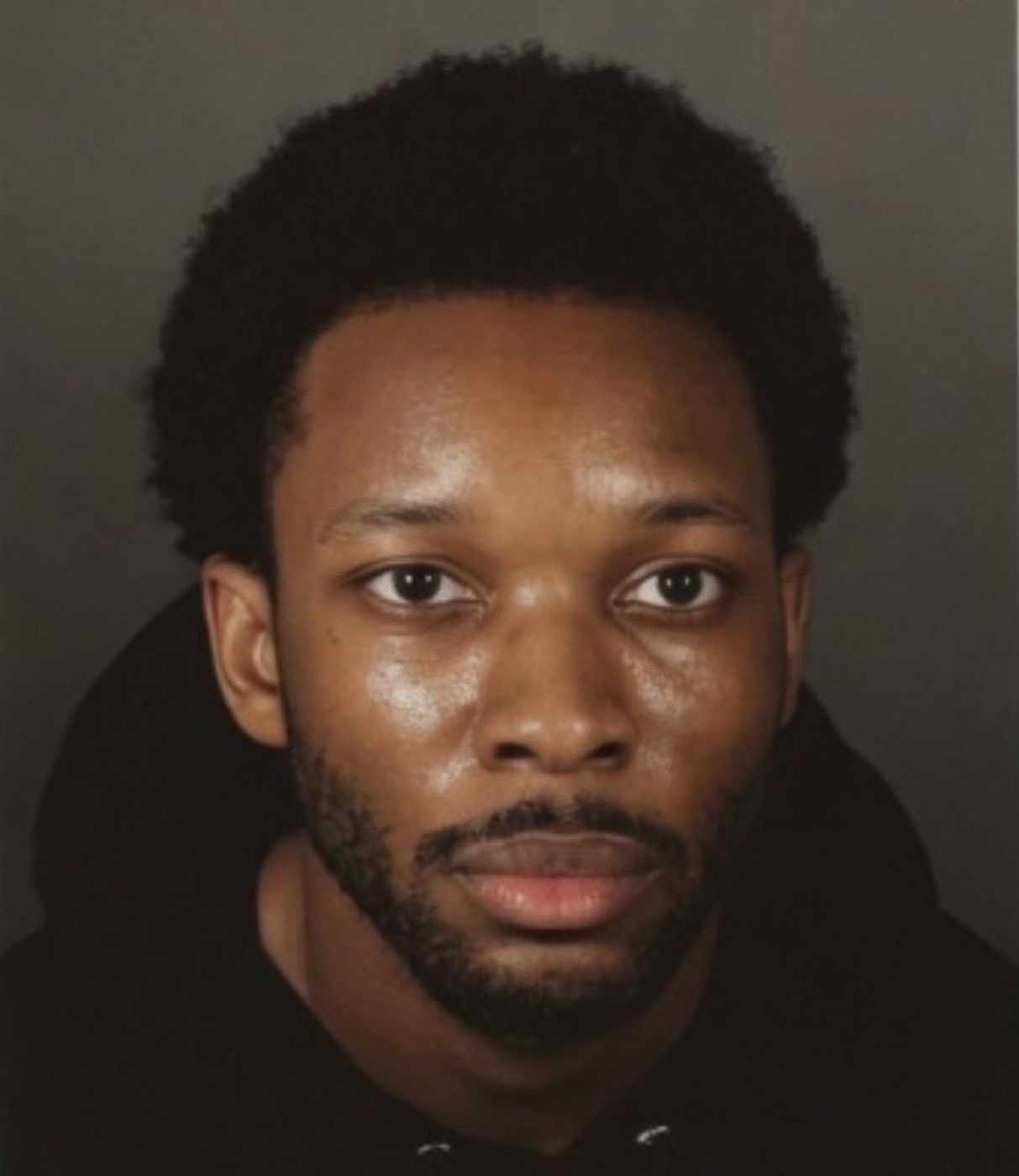
D4vd was formally charged today with the murder of 14-year-old Celeste Rivas Hernandez and entered a not guilty plea to all counts. His attorney entered the plea on his behalf during arraignment at the Clara Shortridge Foltz Criminal Justice Center in Los Angeles. He remains held without bail.
David Anthony Burke faces one count each of murder, continuous sexual abuse of a child under the age of 14, and unlawful mutilation of human remains. The murder charge carries three special circumstance allegations: murder to prevent testimony, murder for financial gain, and murder by lying in wait. Prosecutors also allege Burke used a sharp instrument to commit the crime. If convicted as charged, he faces death or life in state prison without the possibility of parole. A decision on whether to seek the death penalty has not been made.
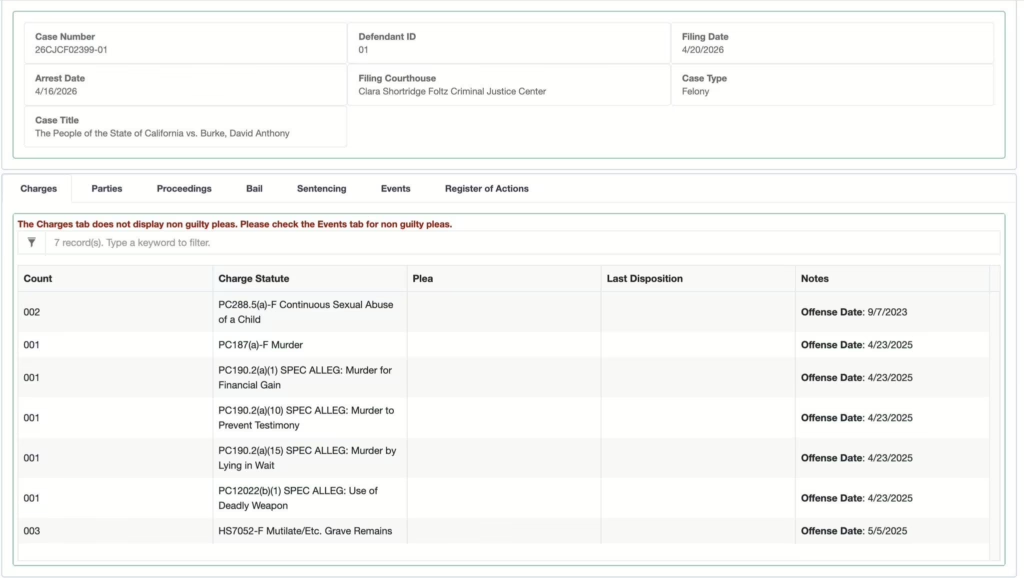
According to the complaint, Burke invited Celeste to his Hollywood Hills home on April 23, 2025. She arrived and was never seen alive again. Court records show the sexual abuse offense date as September 7, 2023, when Celeste was under 14. The mutilation charge carries an offense date of May 5, 2025.
District Attorney Nathan Hochman addressed the case in a statement. “When she threatened to expose his criminal conduct and devastate his musical career, Burke allegedly murdered her, cut up her body and stuffed her body in two bags that were placed in the front trunk of his car,” Hochman said. “There the dismembered body sat for over four months decomposing until it was found at a tow yard on Sept. 8, 2025.”
The case is being prosecuted by Deputy District Attorney Beth Silverman of the Major Crimes Division. As previously reported by miixtapechiick.com, Burke was arrested by complaint on April 16 after the DA’s office declined to seek a grand jury indictment.



The Receipts
Judge Denies Megan Thee Stallion’s Request for Permanent Injunction Against Milagro Gramz
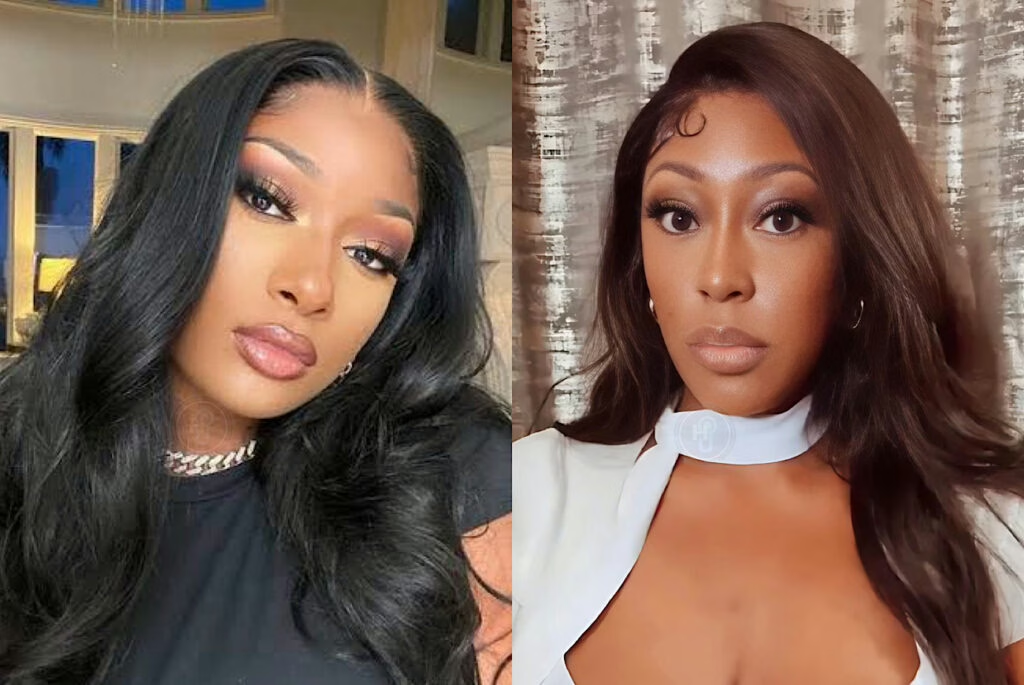
A federal judge in Miami has denied Megan Thee Stallion‘s request for a permanent injunction against Milagro Elizabeth Cooper, the online personality known as Milagro Gramz, ruling that the Grammy-winning rapper, born Megan Pete, failed to meet the legal standard required for the order.
Chief U.S. District Judge Cecilia M. Altonaga issued the decision on Monday, finding that Pete did not show an imminent threat of future harm and that the proposed injunction raised First Amendment concerns significant enough to independently warrant denial.
As previously reported by miixtapechiick.com, Pete sought the injunction after a jury found Cooper liable on three counts following a November and December 2025 trial: defamation per se, intentional infliction of emotional distress, and promotion of an altered sexual depiction. The jury awarded Pete compensatory and punitive damages, and the court kept the cyberstalking injunction question open to decide after the verdict came in. Cooper filed her response in January, arguing pro se that the order Pete was seeking amounted to an unconstitutional restraint on protected speech and was inconsistent with what the jury actually found.
Pete asked the court to bar Cooper from contacting her, require her to stay at least 500 feet away at all times and 1,000 feet from any of her performances, prohibit further defamatory statements about her testimony, mental health, alcohol use, and family, and block any further distribution of the deepfake video. Judge Altonaga narrowed what she would consider at the outset, noting there was no evidence Cooper had ever shown up to Pete’s performances or attempted to locate her in person, and that several of the requested restrictions had no connection to the cyberstalking conduct described in Pete’s petition.
On the cyberstalking claim itself, Judge Altonaga was not convinced Pete had proved it. Florida’s statute requires showing the defendant’s communications were willful and malicious, served no legitimate purpose, and caused substantial emotional distress. The jury’s verdict didn’t resolve those questions cleanly. The jury found Cooper acted “intentionally or recklessly,” and because recklessness falls short of the willfulness and malice the cyberstalking statute requires, the court couldn’t read the verdict as establishing those elements. The judge also pointed to the jury’s finding that Cooper regularly disseminated news and commentary to the public and functioned similarly to traditional media, which worked against Pete’s argument that Cooper’s posts served no legitimate purpose, the same position Cooper had taken in her January response.
The ruling also turned on whether Pete faced a real, ongoing threat that money couldn’t address. Judge Altonaga found she did not. The petition underlying the injunction request was built on the same conduct the jury had already compensated Pete for at trial, and Cooper’s prior social media pages are no longer publicly accessible. Pete did not identify new content that was still circulating or causing harm.
Pete pointed to Cooper’s behavior after the December 2025 verdict as evidence the harassment was continuing, including Cooper’s Instagram Live comments about making a mixtape, a CBS News interview, and social media posts about the jury’s findings. Judge Altonaga reviewed each one and found none of it qualified as cyberstalking under Florida law. On the mixtape comment specifically, the judge read it as evidence that Cooper understood the limits the verdict placed on her, not that she intended to resume the conduct at issue.
Judge Altonaga held that the proposed injunction was overbroad and functioned as a prior restraint on speech, prohibiting future statements not yet found to be defamatory and covering subjects well outside what Cooper had been held liable for at trial. On this record, she found Pete had not shown why the need for an injunction outweighed Cooper’s First Amendment rights.
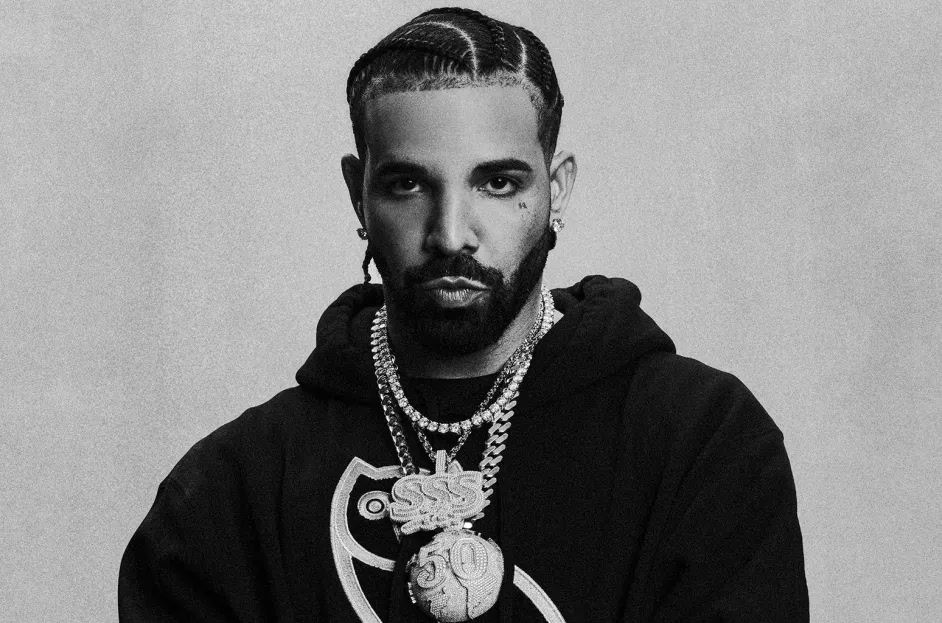
Drake‘s attorneys filed their reply brief at the U.S. Court of Appeals for the Second Circuit on April 17, pushing back on UMG Recordings and a separate group of academics who sided with the label, and arguing the lower court made errors serious enough to require the case be sent back.
As previously reported by miixtapechiick.com, a federal judge dismissed Drake’s defamation lawsuit over Kendrick Lamar‘s “Not Like Us,” and UMG filed its response brief in March asking the Second Circuit to let that ruling stand. Drake’s team, represented by Willkie Farr & Gallagher LLP, says the judge went well outside what the rules allow at the dismissal stage, pulling in outside materials, making factual findings, and drawing conclusions against Drake — all without giving him any chance to respond.
The central argument is about who the court imagined was listening. Drake’s team says the judge didn’t ask how an average listener would understand “Not Like Us.” Instead, the ruling assumed the listener was someone steeped in the full history of the Drake-Lamar feud, familiar with every track exchanged, and already reading the song through that lens. His attorneys say those two audiences are not interchangeable. The reply points out that the second-most-streamed song from the feud had roughly 4.1% of “Not Like Us”‘s total views, which means the vast majority of people who heard the recording hadn’t heard the other songs the ruling relied on for context. Under that math, the brief argues, the court effectively declared 95% of actual listeners unreasonable.
A track called “Taylor Made Freestyle” is where Drake’s team says the lower court’s approach fell apart most clearly. That song wasn’t mentioned anywhere in Drake’s complaint, was only available online for about a week, and doesn’t feature Drake’s own voice — yet the judge cited it as something a reasonable listener would have used to frame the pedophile accusations in “Not Like Us.” Getting there required the court to go outside the complaint and read things in UMG’s favor, both of which are procedurally improper at the dismissal stage. Drake’s attorneys say if the judge wanted to rely on that material, the rules required converting the case to summary judgment first, which would have given Drake the opportunity to present evidence in response. They say that evidence would have included the actual source of the “young girls” line — a 2023 episode of the Joe Budden Podcast that was criticizing Drake for dating women the host considered too young for him, not for any interest in minors.
The reply also takes issue with what the lower court ignored. Drake’s complaint described the cultural moment the song landed in, a period when several high-profile men in entertainment had faced serious criminal and civil consequences for child sex abuse and exploitation. His team argues that context made the pedophile accusations in “Not Like Us” land differently than typical diss track hyperbole, and that real-world reactions — including threats against Drake and an attempted shooting at his home — proved that listeners took the claims seriously. The brief argues the court drew inferences against Drake from disputed outside material while disregarding well-pleaded facts already in the complaint.
On the question of whether the song reached new audiences after its initial release, Drake’s team argues UMG’s position has no legal support. UMG had argued that because the song was already widely known when it was performed at the Super Bowl halftime show, the feud context followed it into that room automatically. Drake’s reply says that’s not how republication works. The complaint described an audience at the Super Bowl that included people who had never heard the song before, and his attorneys argue that performance has to be evaluated on its own terms. They also note that UMG’s own standard recording contract includes a clause allowing the label to remove content it determines constitutes defamation or libel, which his team frames as evidence that the label’s current argument is inconsistent with how it actually operates.
A group of social scientists and legal scholars filed their own brief on April 15 backing UMG’s position, arguing that diss tracks are a well-established format rooted in African American oral tradition, built on exaggeration and competitive insult rather than factual claims. That brief, filed through the UCI Intellectual Property, Arts, and Technology Clinic at the University of California, Irvine, also argued that treating rap lyrics as factual statements in court opens the door to racial bias, citing decades of research showing that exposure to rap evidence produces racially skewed judgments against Black defendants. Drake’s reply addresses it directly, calling their argument that he effectively consented to the pedophile accusations by releasing his own diss tracks “imaginative,” noting that UMG never actually raised that argument itself and that it wouldn’t apply under the law regardless.
UMG filed its oral argument request on April 10, asking the Second Circuit to allow live argument in the case. No date has been scheduled.
News
Cardi B Refuses to Perform at Final Atlanta Show After Argument With State Farm Arena Employees
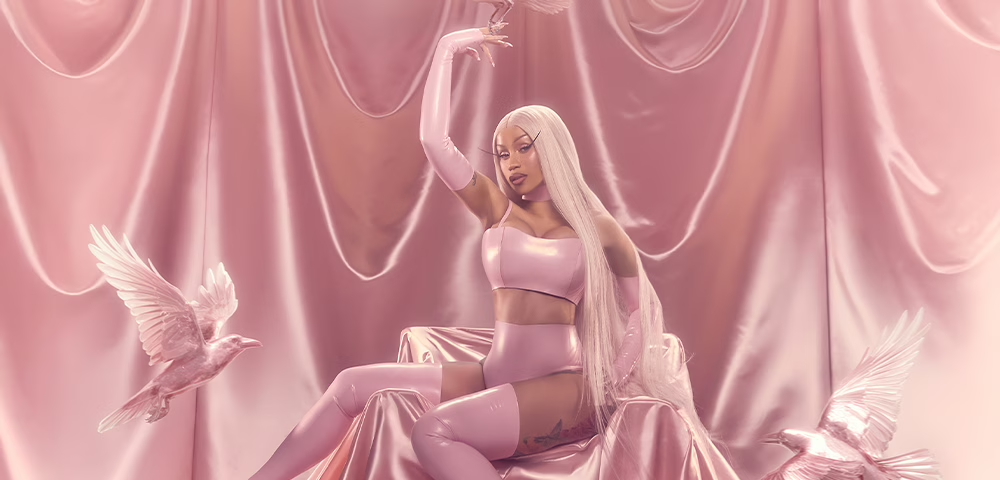
Cardi B went live on Instagram from inside State Farm Arena in Atlanta on Saturday night to announce she would not be performing at the final stop of the Little Miss Drama Tour, citing a dispute with arena employees.
“Here on live right here because you and your f****** employees are being disrespectful,” she said. “Why I’m not going to perform today? Cuz you’re being — go get your boss like you said. Go get them. I’m not performing today. Let me tell you why. Because we got in here. Your employees are being f****** rude for no reason. Being rude for no reason. Pointing fingers for no reason. Touching people for no reason. And then they telling me, ‘Oh, we got to talk to this because I feel a certain type of way cuz you being disrespectful.’ I did 35 shows and I never had a problem and we’ve been kind to everybody. So, no, now I’m leaving. No.”
Saturday’s show was the second of two Atlanta dates. The night before, Cardi brought out Mariah the Scientist, T.I., and Jeezy. Ludacris, Angel Reese, Kandi, Latto, and Santana were among those spotted in attendance across both nights.
As previously reported by miixtapechiick.com, the Little Miss Drama Tour has included surprise appearances from Megan Thee Stallion, Lil Kim, Meek Mill, A Boogie Wit da Hoodie, Vybz Kartel and others throughout the run.
-
 News4 days ago
Tsu Surf Released from Michigan Prison on Parole
-
 Culture7 days ago
Rihanna Steps Out in Paris With Daughter Rocki Irish Mayers
-
 News2 days ago
Cardi B Refuses to Perform at Final Atlanta Show After Argument With State Farm Arena Employees
-
 News4 days ago
Queen Naija Announces Engagement to Clarence White
-
 News2 days ago
Pooh Shiesty Transferred to Texas; New Mugshot Released